(55637) 2002 UX25 is a trans-Neptunian object that orbits the Sun in the Kuiper belt beyond Neptune. This TNO briefly garnered scientific attention when it was found to have an unexpectedly low density of about 0.82 g/cm3.[12]
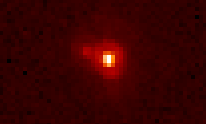
2002 UX25 has an absolute magnitude of about 4.0,[1] and Spitzer Space Telescope results estimate it to be about 681 km in diameter.[13] The low density of this and many other mid sized TNO's implies that they have likely never compressed into fully solid bodies, let alone differentiated or collapsed into hydrostatic equilibrium, and so are highly unlikely to be dwarf planets.[14]
It was discovered on 30 October 2002, by the Spacewatch program.[15]
Numbering and naming
This minor planet was numbered by the Minor Planet Center on 16 February 2003.[16] As of 2020, it has not been named.[17]
Classification
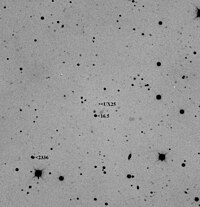
2002 UX25 has a perihelion of 36.7 AU,[1] which it will next reach in 2065.[1] As of 2020, 2002 UX25 is 40 AU from the Sun.[11]
The Minor Planet Center classifies 2002 UX25 as a cubewano[2] while the Deep Ecliptic Survey (DES) classifies it as scattered-extended.[3] The DES using a 10 My integration (last observation: 2009-10-22) shows it with a minimum perihelion (qmin) distance of 36.3 AU.[3]
It has been observed 212 times with precovery images dating back to 1991.[1]
Dwarf-planet status
2002 UX25 has an estimated diameter of about 660 km,[7][8] and most icy objects larger than 400 km in diameter were thought to be spherical.[18] Michael Brown's website lists it as highly likely a dwarf planet.[19] However, light-curve analysis has questioned whether it is actually a dwarf planet.[20][21] Grundy et al. suggest that the low densities common in mid sized TNOs like this one implies that they have retained significant internal porosity from their formation, in which case they would not be dwarf planets.[22]
Physical characteristics
A variability of the visual brightness was detected which could be fit to a period of 14.38 or 16.78 h (depending on a single-peaked or double peaked curve).[23] The light-curve amplitude is ΔM = 0.21±0.06.[9]
The analysis of combined thermal radiometry of 2002 UX25 from measurements by the Spitzer Space Telescope and Herschel Space Telescope indicates an effective diameter of 692 ± 23 km and albedo of 0.107+0.005
−0.008. Assuming equal albedos for the primary and secondary it leads to the size estimates of ~664 km and ~190 km, respectively. If the albedo of the secondary is half of that of the primary the estimates become ~640 and ~260 km, respectively.[6] Using an improved thermophysical model slightly different sizes were obtained for UX25 and its satellite: 659 km and 230 km, respectively.[8]
2002 UX25 has red featureless spectrum in the visible and near-infrared but has a negative slope in the K-band, which may indicate the presence of the methanol compounds on the surface.[7] It is redder than Varuna, unlike its neutral-colored "twin" 2002 TX300, in spite of similar brightness and orbital elements.
Composition
With a density of 0.82 g/cm3, assuming that the primary and satellite have the same density, 2002 UX25 is one of the largest known solid objects in the Solar System that is less dense than water.[12] Why this should be is not well understood, because objects of its size in the Kuiper belt often contain a fair amount of rock and are hence pretty dense. To have a similar composition to others large KBOs, it would have to be exceptionally porous, which was believed to be unlikely given the compactability of water ice;[6] this low density thus astonished astronomers.[12] Studies by Grundy et al. suggest that at the low temperatures that prevail beyond Neptune, ice is brittle and can support significant porosity in objects significantly larger than 2002 UX25, particularly if rock is present; the low density could thus be a consequence of this object failing to warm sufficiently during its formation to significantly deform the ice and fill these pore spaces.[24]
Satellite

The discovery of a minor-planet moon was reported in IAUC 8812 on 22 February 2007.[5] The satellite was detected using the Hubble Space Telescope in August 2005.[5] The satellite was found at 0.16 arcsec from the primary with an apparent magnitude difference of 2.5.[27] It orbits the primary in 8.309±0.0002 days,[9] at a distance of 4770±40 km, yielding a system mass of (1.25±0.03)×1020 kg.[6][9] The eccentricity of the orbit is 0.17±0.03.[9]
This moon is estimated to be 210±30 km in diameter.[7] Assuming the same albedo as the primary, it would have a diameter of 190 km, assuming an albedo of 0.05 (typical of other cold, classical KBOs of similar size) a diameter of 260 km.[6]
| This article uses material from the Wikipedia article Metasyntactic variable, which is released under the Creative Commons Attribution-ShareAlike 3.0 Unported License. |