Detached object

 Detached objects are a dynamical class of minor planets in the outer reaches of the Solar System and belong to the broader family of trans-Neptunian objects (TNOs). These objects have orbits whose points of closest approach to the Sun (perihelion) are sufficiently distant from the gravitational influence of Neptune that they are only moderately affected by Neptune and the other known planets: This makes them appear to be "detached" from the rest of the Solar System, except for their attraction to the Sun.[1][2]
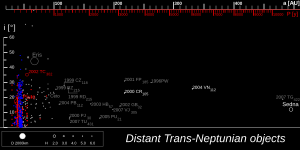
Trans-Neptunian objects plotted by their distance and inclination. Objects beyond a distance of 100 AU display their designation.
  Resonant TNO & Plutino
  Cubewanos (classical KBO)
  Scattered disc object
  Detached object

In this way, detached objects differ substantially from most other known TNOs, which form a loosely defined set of populations that have been perturbed to varying degrees onto their current orbit by gravitational encounters with the giant planets, predominantly Neptune. Detached objects have larger perihelia than these other TNO populations, including the objects in orbital resonance with Neptune, such as Pluto, the classical Kuiper belt objects in non-resonant orbits such as Makemake, and the scattered disk objects like Eris.

Detached objects have also been referred to in the scientific literature as extended scattered disc objects (E-SDO),[3] distant detached objects (DDO),[4] or scattered–extended, as in the formal classification by the Deep Ecliptic Survey.[5] This reflects the dynamical gradation that can exist between the orbital parameters of the scattered disk and the detached population.

At least nine such bodies have been securely identified,[6] of which the largest, most distant, and best known is Sedna. Those with perihelia far beyond the Kuiper cliff are termed sednoids. As of 2018, there are three known sednoids, Sedna, 2012 VP113, and Leleākūhonua.

OrbitsEdit

Detached objects have perihelia much larger than Neptune's aphelion. They often have highly elliptical, very large orbits with semi-major axes of up to a few hundred astronomical units (AU, the radius of Earth's orbit). Such orbits cannot have been created by gravitational scattering by the giant planets, not even Neptune. Instead, a number of explanations have been put forward, including an encounter with a passing star[7] or a distant planet-sized object,[4] or Neptune itself (which may once have had a much more eccentric orbit, from which it could have tugged the objects to their current orbit)[8][9][10][11][12] or ejected planets (present in the early Solar System that were ejected).[13][14][15]

The classification suggested by the Deep Ecliptic Survey team introduces a formal distinction between scattered-near objects (which could be scattered by Neptune) and scattered-extended objects (e.g. 90377 Sedna) using a Tisserand's parameter value of 3.[5]

The Planet Nine hypothesis suggests that the orbits of several detached objects can be explained by the gravitational influence of a large, unobserved planet between 200 AU and 1200 AU from the Sun and/or the influence of Neptune.[16]

ClassificationEdit

Detached objects are one of five distinct dynamical classes of TNO; the other four classes are classical Kuiper-belt objectsresonant objectsscattered-disc objects (SDO), and sednoids. Detached objects generally have a perihelion distance greater than 40 AU, deterring strong interactions with Neptune, which has an approximately circular orbit about 30 AU from the Sun. However, there are no clear boundaries between the scattered and detached regions, since both can coexist as TNOs in an intermediate region with perihelion distance between 37 and 40 AU.[6] One such intermediate body with a well determined orbit is (120132) 2003 FY128.

The discovery of 90377 Sedna in 2003, together with a few other objects discovered around that time such as (148209) 2000 CR105 and 2004 XR190, has motivated discussion of a category of distant objects that may also be inner Oort cloud objects or (more likely) transitional objects between the scattered disc and the inner Oort cloud.[2]

Although Sedna is officially considered a scattered-disc object by the MPC, its discoverer Michael E. Brown has suggested that because its perihelion distance of 76 AU is too distant to be affected by the gravitational attraction of the outer planets it should be considered an inner-Oort-cloud object rather than a member of the scattered disc.[17] This classification of Sedna as a detached object is accepted in recent publications.[18]

This line of thinking suggests that the lack of a significant gravitational interaction with the outer planets creates an extended–outer group starting somewhere between Sedna (perihelion 76 AU) and more conventional SDOs like 1996 TL66 (perihelion 35 AU), which is listed as a scattered–near object by the Deep Ecliptic Survey.[19]

Influence of NeptuneEdit

One of the problems with defining this extended category is that weak resonances may exist and would be difficult to prove due to chaotic planetary perturbations and the current lack of knowledge of the orbits of these distant objects. They have orbital periods of more than 300 years and most have only been observed over a short observation arc of a couple years. Due to their great distance and slow movement against background stars, it may be decades before most of these distant orbits are determined well enough to confidently confirm or rule out a resonance. Further improvement in the orbit and potential resonance of these objects will help to understand the migration of the giant planets and the formation of the Solar System. For example, simulations by Emel’yanenko and Kiseleva in 2007 show that many distant objects could be in resonance with Neptune. They show a 10% likelihood that 2000 CR105 is in a 20:1 resonance, a 38% likelihood that 2003 QK91 is in a 10:3 resonance, and an 84% likelihood that (82075) 2000 YW134 is in an 8:3 resonance.[20] The likely dwarf planet (145480) 2005 TB190 appears to have less than a 1% likelihood of being in a 4:1 resonance.[20]

Influence of hypothetical planet(s) beyond NeptuneEdit

Mike Brown—who made the Planet Nine hypothesis—makes an observation that "all of the known distant objects which are pulled even a little bit away from the Kuiper seem to be clustered under the influence of this hypothetical planet (specifically, objects with semimajor axis > 100 AU and perihelion > 42 AU)."[21] Carlos de la Fuente Marcos and Ralph de la Fuente Marcos have calculated that some of the statistically significant commensurabilities are compatible with the Planet Nine hypothesis; in particular, a number of objects[a] which are called Extreme trans Neptunian objects (ETNOs).[24] may be trapped in the 5:3 and 3:1 mean-motion resonances with a putative Planet Nine with a semimajor axis ∼700 AU.[25]

Possible detached objectsEdit

This is a list of known objects by decreasing perihelion, that could not be easily scattered by Neptune's current orbit and therefore are likely to be detached objects, but that lie inside the perihelion gap of ≈50–75 AU that defines the sednoids:[26][27][28][29][30][31]

Objects listed below have a perihelion of more than 40 AU, and a semimajor axis of more than 47.7 AU (the 1:2 resonance with Neptune, and the approximate outer limit of the Kuiper Belt) [32]

DesignationDiameter [33]
(km)
Hq
(AU)
a
(AU)
Q
(AU)
ω (°)Discovery
Year
DiscovererNotes & Refs
2000 CR1052436.344.252221.2398316.932000M. W. Buie[34]
2000 YW1342164.741.20757.79574.383316.4812000Spacewatch≈3:8 Neptune resonance
2001 FL193818.740.2950.2660.23108.62001R. L. AllenG. BernsteinR. Malhotraorbit extremely poor, might not be a TNO
2001 KA776345.043.4147.7452.07120.32001M. W. Buieborderline classical KBO
2002 CP1542226.5425262502002M. W. Buieorbit fairly poor, but definitely a detached object
2003 UY2911477.441.1948.9556.7215.62003M. W. Buieborderline classical KBO
Sedna9951.576.072483.3890311.612003M. E. BrownC. A. TrujilloD. L. RabinowitzSednoid
2004 PD1122676.1407090402004M. W. Buieorbit very poor, might not be a detached object
2004 VN1122226.547.308315584326.9252004Cerro Tololo (unspecified)[35][36][37]
2004 XR1906124.151.08557.33663.586284.932004R. L. AllenB. J. GladmanJ. J. Kavelaars
J.-M. PetitJ. W. ParkerP. Nicholson
pseudo-Sednoid, very high inclination; Neptune Mean Motion Resonance (MMR) along with the Kozai Resonance (KR) modified the eccentricity and inclination of 2004 XR190 to obtain a very high perihelion[34][38][39]
2005 CG812676.141.0354.1067.1857.122005CFEPS
2005 EO2971617.241.21562.9884.75349.862005M. W. Buie
2005 TB1903724.546.19775.546104.896171.0232005A. C. BeckerA. W. PuckettJ. M. KubicaNeptune Mean Motion Resonance (MMR) along with the Kozai Resonance (KR) modified the eccentricity and inclination to obtain a high perihelion[39]
2006 AO1011687.1--------2006Mauna Kea (unspecified)orbit extremely poor, might not be a TNO
2007 JJ435584.540.38348.39056.3976.5362007Palomar (unspecified)borderline classical KBO
2007 LE381767.041.79854.5667.3253.962007Mauna Kea (unspecified)
2008 ST2916404.242.2799.3156.4324.372008M. E. SchwambM. E. BrownD. L. Rabinowitz≈1:6 Neptune resonance
2009 KX361118.0--100100--2009Mauna Kea (unspecified)orbit extremely poor, might not be a TNO
2010 DN934864.745.10255.50165.9033.012010Pan-STARRS≈2:5 Neptune resonance; Neptune Mean Motion Resonance (MMR) along with the Kozai Resonance (KR) modified the eccentricity and inclination to obtain a high perihelion[39]
2010 ER654045.040.03599.71159.39324.192010D. L. RabinowitzS. W. Tourtellotte
2010 GB1742226.548.8360670347.72010Mauna Kea (unspecified)
2012 FH841617.2425670102012Las Campanas (unspecified)
2012 VP1137024.080.47256431293.82012S. S. SheppardC. A. TrujilloSednoid
2013 FQ282806.045.963.180.32302013S. S. SheppardC. A. Trujillo≈1:3 Neptune resonance; Neptune Mean Motion Resonance (MMR) along with the Kozai Resonance (KR) modified the eccentricity and inclination to obtain a high perihelion[39]
2013 FT282026.743.531058040.32013S. S. Sheppard
2013 GP1362126.641.061155.1269.142.382013OSSOS
2013 GQ1362226.540.7949.0657.33155.32013OSSOSborderline classical KBO
2013 GG1382126.646.6447.79248.9461282013OSSOSborderline classical KBO
2013 JD641118.042.60373.12103.63178.02013OSSOS
2013 JJ641477.444.0448.15852.272179.82013OSSOSborderline classical KBO
2013 SY992026.750.02694133832.12013OSSOS
2013 SK1001347.645.46861.6177.7611.52013OSSOS
2013 UT152556.343.89195.7348252.332013OSSOS
2013 UB171767.044.4962.3180.13308.932013OSSOS
2013 VD241287.84050701972013Dark Energy Surveyorbit very poor, might not be a detached object
2013 YJ1513365.440.86672.35103.83141.832013Pan-STARRS
2014 EZ517703.740.7052.4964.28329.842014Pan-STARRS
2014 FC695334.640.2873.06105.8190.572014S. S. SheppardC. A. Trujillo
2014 FZ711856.955.976.296.52452014S. S. SheppardC. A. Trujillopseudo-Sednoid; ≈1:4 Neptune resonance; Neptune Mean Motion Resonance (MMR) along with the Kozai Resonance (KR) modified the eccentricity and inclination to obtain a very high perihelion[39]
2014 FC725094.551.67076.329100.9932.852014Pan-STARRSpseudo-Sednoid; ≈1:4 Neptune resonance; Neptune Mean Motion Resonance (MMR) along with the Kozai Resonance (KR) modified the eccentricity and inclination to obtain a very high perihelion[39]
2014 JM803525.546.0063.0080.0196.12014Pan-STARRS≈1:3 Neptune resonance; Neptune Mean Motion Resonance (MMR) along with the Kozai Resonance (KR) modified the eccentricity and inclination to obtain a high perihelion[39]
2014 JS803065.540.01348.29156.569174.52014Pan-STARRSborderline classical KBO
2014 OJ3944235.040.8052.9765.14271.602014Pan-STARRSin 3:7 Neptune resonance
2014 QR4411936.842.667.893.02832014Dark Energy Survey
2014 SR3492026.647.6300540341.12014S. S. SheppardC. A. Trujillo
2014 SS3491347.6451402401482014S. S. SheppardC. A. Trujillo≈2:10 Neptune resonance; Neptune Mean Motion Resonance (MMR) along with the Kozai Resonance (KR) modified the eccentricity and inclination to obtain a high perihelion[40]
2014 ST3733305.550.13104.0157.8297.522014Dark Energy Survey
2014 UT2281547.343.9748.59353.21649.92014OSSOSborderline classical KBO
2014 UA2302226.542.2755.0567.84132.82014OSSOS
2014 UO231978.342.2555.1167.98234.562014OSSOS
2014 WK5095844.040.0850.7961.50135.42014Pan-STARRS
2014 WB5561477.442.62805202342014Dark Energy Survey
2015 AL2812936.14248541202015Pan-STARRSborderline classical KBO
orbit very poor, might not be a detached object
2015 AM2814864.841.38055.37269.364157.722015Pan-STARRS
2015 BE5193525.544.8247.86650.909293.22015Pan-STARRSborderline classical KBO
2015 FJ3451177.95163.075.2782015S. S. SheppardC. A. Trujillopseudo-Sednoid; ≈1:3 Neptune resonance; Neptune Mean Motion Resonance (MMR) along with the Kozai Resonance (KR) modified the eccentricity and inclination to obtain a very high perihelion[39]
2015 GP502226.540.455.270.01302015S. S. SheppardC. A. Trujillo
2015 KH1626713.941.6362.2982.95296.8052015S. S. SheppardD. J. TholenC. A. Trujillo
2015 KG1631018.340.502826161032.062015OSSOS
2015 KH1631177.940.06157.2274230.292015OSSOS≈1:12 Neptune resonance
2015 KE1721068.144.137133.12222.115.432015OSSOS1:9 Neptune resonance
2015 KG1722806.0425569352015R. L. Allen
D. James
D. Herrera
orbit fairly poor, might not be a detached object
2015 KQ1741547.349.3155.4061.48294.02015Mauna Kea (unspecified)pseudo-Sednoid; ≈2:5 Neptune resonance; Neptune Mean Motion Resonance (MMR) along with the Kozai Resonance (KR) modified the eccentricity and inclination to obtain a very high perihelion[39]
2015 RX2452556.245.541078065.32015OSSOS
Leleākūhonua3005.565.0210422019118.02015S. S. SheppardC. A. TrujilloD. J. TholenSednoid
2017 DP1211617.240.5250.4860.45217.92017
2017 FP1611687.140.8847.9955.12182017borderline classical KBO
2017 SN132975.840.94979.868118.786148.7692017S. S. SheppardC. A. TrujilloD. J. Tholen
2018 VM351347.645.289240.575435.861302.0082018???

The following objects can also be generally thought to be detached objects, although with slightly lower perihelion distances of 38-40 AU.

DesignationDiameter [33]
(km)
Hq
(AU)
a
(AU)
Q
(AU)
ω (°)Discovery
Year
DiscovererNotes & Refs
2003 HB571477.438.116166.229411.0822003Mauna Kea (unspecified)
2003 SS422168>7.1392004002102003Cerro Tololo (unspecified)orbit very poor, might not be a detached object
2005 RH521287.838.957152.6266.332.2852005CFEPS
2007 TC4341687.039.577128.41217.23351.0102007Las Campanas (unspecified)1:9 Neptune resonance
2012 FL842126.638.607106.25173.89141.8662012Pan-STARRS
2014 FL721936.838.1104170259.492014Cerro Tololo (unspecified)
2014 JW803525.538.161142.62247.1131.612014Pan-STARRS
2014 YK502935.638.972120.52202.1169.312014Pan-STARRS
2015 GT50888.638.46333627129.32015OSSOS

This article uses material from the Wikipedia article
 Metasyntactic variable, which is released under the 
Creative Commons
Attribution-ShareAlike 3.0 Unported License
.