The following is a list of numbered minor planets in ascending numerical order. With the exception of comets, minor planets are all small bodies in the Solar System, including asteroids, distant objects and dwarf planets. The catalog consists of hundreds of pages, each containing 1000 minor planets. On behalf of the International Astronomical Union, the Minor Planet Center publishes thousands of newly numbered minor planets in its Minor Planet Circulars every year (see index).[1][2] As of July 2021, there are 567,132 numbered minor planets (secured discoveries) out of a total of 1,092,846 observed bodies, with the remainder being unnumbered minor planets and comets.[3][4]
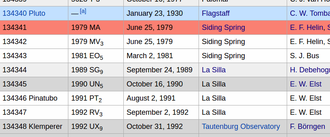

- numbered and named bodies (listed)
- numbered but unnamed bodies (listed)
- unnumbered bodies (not part of this list)
The catalog's first object is 1 Ceres, discovered by Giuseppe Piazzi in 1801, while its best-known entry is Pluto, listed as 134340 Pluto. The vast majority (97%) of minor planets are asteroids from the asteroid belt (the catalog uses a color code to indicate a body's dynamical classification). There are more than a thousand different minor-planet discoverers observing from a growing list of registered observatories. In terms of numbers, the most prolific discoverers are Spacewatch, LINEAR, MLS, NEAT and CSS. There are also 22,609 named minor planets mostly after people, places and figures from mythology and fiction,[4][5] while 96% of all numbered catalog entries remain unnamed. (4596) 1981 QB and 551231 Żywiec are currently the lowest-numbered unnamed and highest-numbered named minor planets, respectively.[1][5]
It is expected that the upcoming survey by the Vera C. Rubin Observatory (LSST) will discover another 5 million minor planets during the next ten years—a tenfold increase from current numbers.[6] While all main-belt asteroids with a diameter above 10 kilometers have already been discovered, there might be as many as 10 trillion 1-meter-sized asteroids or larger out to the orbit of Jupiter; and more than a trillion minor planets in the Kuiper belt of which hundreds are likely dwarf planets.[6][7] For minor planets grouped by a particular aspect or property, see § Specific lists.
Description of partial lists
The list of minor planets consists of more than 500 partial lists, each containing 1000 minor planets grouped into 10 tables. The data is sourced from the Minor Planet Center (MPC) and expanded with data from the JPL SBDB (mean-diameter), Johnston's archive (sub-classification) and others (see detailed field descriptions below). For an overview of all existing partial lists, see § Main index.
The information given for a minor planet includes a permanent and provisional designation (§ Designation), a citation that links to the meanings of minor planet names (only if named), the discovery date, location, and credited discoverers (§ Discovery and § Discoverers), a category with a more refined classification than the principal grouping represented by the background color (§ Category), a mean-diameter, sourced from JPL's SBDB or otherwise calculated estimates in italics (§ Diameter), and a reference (Ref) to the corresponding pages at MPC and JPL SBDB.
The MPC may credit one or several astronomers, a survey or similar program, or even the observatory site with the discovery. In the first column of the table, an existing stand-alone article is linked in boldface, while (self-)redirects are never linked. Discoverers, discovery site and category are only linked if they differ from the preceding catalog entry.
Example
The example above shows five catalog entries from one of the partial lists. All five asteroids were discovered at Palomar Observatory by the Palomar–Leiden survey (PLS). The MPC directly credits the survey's principle investigators, that is, the astronomers Cornelis van Houten, Ingrid van Houten-Groeneveld and Tom Gehrels. (This is the only instance where the list of minor planets diverges from the Discovery Circumstances in the official MPC list.[8]) 189004 Capys, discovered on 16 October 1977, is the only named minor planet. Its background color indicates that it is a Jupiter trojan (from the Trojan camp at Jupiter's L5), estimated to be approximately 12 kilometers in diameter. All other objects are smaller asteroids from the inner (white), central (light-grey) and outer regions (dark grey) of the asteroid belt. The provisional designation for all objects is an uncommon survey designation.
Designation
After discovery, minor planets generally receive a provisional designation, e.g. 1989 AC, then a leading sequential number in parenthesis, e.g. (4179) 1989 AC, turning it into a permanent designation (numbered minor planet). Optionally, a name can be given, replacing the provisional part of the designation, e.g. 4179 Toutatis. (On Wikipedia, named minor planets also drop their parenthesis.)
In modern times, a minor planet receives a sequential number only after it has been observed several times over at least 4 oppositions.[9] Minor planets whose orbits are not (yet) precisely known are known by their provisional designation. This rule was not necessarily followed in earlier times, and some bodies received a number but subsequently became lost minor planets. The 2000 recovery of 719 Albert, which had been lost for nearly 89 years, eliminated the last numbered lost asteroid.[10] Only after a number is assigned is the minor planet eligible to receive a name. Usually the discoverer has up to 10 years to pick a name; many minor planets now remain unnamed. Especially towards the end of the twentieth century, large-scale automated asteroid discovery programs such as LINEAR have increased the pace of discoveries so much that the vast majority of minor planets will most likely never receive names.
For these reasons, the sequence of numbers only approximately matches the timeline of discovery. In extreme cases, such as lost minor planets, there may be a considerable mismatch: for instance the high-numbered 69230 Hermes was originally discovered in 1937, but it was a lost until 2003. Only after it was rediscovered could its orbit be established and a number assigned.

- Spacewatch: 160,697 (28.3%)
- LINEAR: 149,948 (26.4%)
- Mt. Lemmon Srvy..: 76,083 (13.4%)
- NEAT: 42,468 (7.5%)
- CSS: 29,366 (5.2%)
- LONEOS: 22,628 (4.0%)
- Pan-STARRS: 14,783 (2.6%)
- Palomar–Leiden Srvy.: 4,643 (0.8%)
- WISE: 4,627 (0.8%)
- Eric Elst: 3,869 (0.7%)
- All others: 58,020 (10.2%)
Discoverers
The MPC credits more than 1000 professional and amateur astronomers as discoverers of minor planets. Many of them have discovered only a few minor planets or even just co-discovered a single one. Moreover, a discoverer does not need to be a human being. There are about 300 programs, surveys and observatories credited as discoverers. Among these, a small group of U.S. programs and surveys actually account for most of all discoveries made so far (see pie chart). As the total of numbered minor planets is growing by the tens of thousands every year, all statistical figures are constantly changing. In contrast to the Top 10 discoverers displayed in this articles, the MPC summarizes the total of discoveries somewhat differently, that is by a distinct group of discoverers. For example, bodies discovered in the Palomar–Leiden Survey are directly credited to the program's principal investigators.
Discovery site
Observatories, telescopes and surveys that report astrometric observations of small Solar System bodies to the MPC receive a numeric or alphanumeric code such as 675 for the Palomar Observatory, or I41 for the Palomar Transient Factory, a dedicated survey that was conducted at Palomar Observatory during 2009–2012. On numbering, such an observatory may directly be credited by the MPC as discoverer.
Category
In this catalog, minor planets are classified into one of 8 principal orbital groups and highlighted with a distinct color. These are:
The vast majority of minor planets are evenly distributed between the inner-, central and outer parts of the asteroid belt, which are separated by the two Kirkwood gaps at 2.5 and 2.82 AU. Nearly 97.5% of all minor planets are main-belt asteroids (MBA), while Jupiter trojans, Mars-crossing and near-Earth asteroids each account for 1% or less of the overall population. Only a small number of distant minor planets, that is the centaurs and trans-Neptunian objects, have been numbered so far. In the partial lists, table column "category" further refines this principal grouping:
- main-belt asteroids show their family membership based on the synthetic hierarchical clustering method by Nesvorný (2014),[13][a]
- resonant asteroids are displayed by their numerical ratio and include the Hildas (3:2), Cybeles (7:4), Thules (4:3) and Griquas (2:1), while the Jupiter trojans (1:1) display whether they belong to the Greek (L4) or Trojan camp (L5),[14]
- Hungaria asteroids (H), are labelled in italics (H), when they are not members of the collisional family[15]
- near-Earth objects are divided into the Aten (ATE), Amor (AMO), Apollo (APO), and Atira (ATI) group,[b] with some of them being potentially hazardous asteroids (PHA),[16] and/or larger than one kilometer in diameter (+1km) as determined by the MPC.[15]
- trans-Neptunian objects are divided into dynamical subgroups including cubewanos (hot or cold), scattered disc objects, plutinos and other Neptunian resonances,[17]
- comet-like and/or retrograde objects with a TJupiter value below 2 are tagged with damocloid,
- other unusual objects based on MPC's and Johnston's lists are labelled unusual,[18]
- binary and trinary minor planets with companions are tagged with "moon" and link to their corresponding entry in minor-planet moon,[19] and
- objects with an exceptionally long or short rotation period are tagged with "slow" (period of 100+ hours) or "fast" (period of less than 2.2 hours) and link to their corresponding entry in List of slow rotators and List of fast rotators, respectively.[20]
- (a) NEO-subgroups with number of members: Aten (237), Amor (1,209), Apollo (1,481) and Atira (6) asteroids.[b]
- (b) Including 29 unclassified bodies: 6144 Kondojiro, 8373 Stephengould, 9767 Midsomer Norton, (18916) 2000 OG44, (32511) 2001 NX17, (96177) 1984 BC, (115916) 2003 WB8, (136620) 1994 JC, (144870) 2004 MA8, (241944) 2002 CU147, (275618) 2000 AU242, (301964) 2000 EJ37, (306418) 1998 KK56, (322713) 2000 KD41, (363135) 2001 QQ199, (393350) 1992 RN1, (405058) 2001 TX16, (406803) 2008 UX64, (477587) 2010 JT86, (487496) 2014 SE288, (490171) 2008 UD253, (494667) 2001 WX1, (497009) 2003 BU35, (497619) 2006 QL39, (504160) 2006 SV301, 514107 Kaʻepaokaʻawela, (518509) 2006 FZ51, (524114) 2000 SB1, (526889) 2007 GH6 (colored as for being unclassified).[c]
- (c) This chart has been created using a classification scheme adopted from and with data provided by the JPL Small-Body Database.[21][d]
Diameter
If available, a minor planet's mean diameter in meters (m) or kilometers (km) is taken from the NEOWISE mission of NASA's Wide-field Infrared Survey Explorer, which the Small-Body Database has also adopted.[22] Mean diameters are rounded to two significant figures if smaller than 100 kilometers. Estimates are in italics and calculated from a magnitude-to-diameter conversion, using an assumed albedo derived from the body's orbital parameters or, if available, from a family-specific mean albedo (also see asteroid family table).[e]
Main index
This is an overview of all existing partial lists of numbered minor planets (LoMP). Each table stands for 100,000 minor planets, each cell for a specific partial list of 1,000 sequentially numbered bodies. The data is sourced from the Minor Planet Center.[1] For an introduction, see § top.
Numberings 1–100,000
Numberings 100,001–200,000
Numberings 200,001–300,000
Numberings 300,001–400,000
Numberings 400,001–500,000
Numberings 500,001–600,000
Specific lists

The following are lists of minor planets by physical properties, orbital properties, or discovery circumstances:
- List of exceptional asteroids (physical properties)
- List of slow rotators (minor planets)
- List of fast rotators (minor planets)
- List of tumblers (small Solar System bodies)
- List of instrument-resolved minor planets
- List of Jupiter trojans (Greek camp)
- List of Jupiter trojans (Trojan camp)
- List of minor planets visited by spacecraft
- List of minor planet moons
- List of minor-planet groups
- List of named minor planets (alphabetical)
- List of named minor planets (numerical)
- List of possible dwarf planets
- List of trans-Neptunian objects
- List of unnumbered minor planets
- List of unnumbered trans-Neptunian objects
- Meanings of minor planet names
- List of minor planets named after people
- List of minor planets named after places
- List of minor planets named after rivers
- List of minor planets named after animals and plants
| This article uses material from the Wikipedia article Metasyntactic variable, which is released under the Creative Commons Attribution-ShareAlike 3.0 Unported License. |