The number of dwarf planets in the Solar System is unknown. Estimates have run as high as 200 in the Kuiper belt[1] and over 10,000 in the region beyond.[2] However, consideration of the surprisingly low densities of many dwarf-planet candidates suggests that the numbers may be much lower (e.g. at most 10 among bodies known so far).[3] The International Astronomical Union (IAU) notes five in particular: Ceres in the inner Solar System and four in the trans-Neptunian region: Pluto, Eris, Haumea, and Makemake, the last two of which were accepted as dwarf planets for naming purposes. Only Pluto is confirmed as a dwarf planet, and it has also been declared one by the IAU independently of whether it meets the IAU definition of a dwarf planet.
IAU naming procedures
In 2008, the IAU modified its naming procedures such that objects considered most likely to be dwarf planets receive differing treatment than others. Objects that have an absolute magnitude (H) less than +1, and hence a minimum diameter of 838 kilometres (521 mi) if the albedo is below 100%,[4] are overseen by two naming committees, one for minor planets and one for planets. Once named, the objects are declared to be dwarf planets. Makemake and Haumea are the only objects to have proceeded through the naming process as presumed dwarf planets; currently there are no other bodies that meet this criterion. All other bodies are named by the minor-planet naming committee alone, and the IAU has not stated how or if they will be accepted as dwarf planets.
Limiting values

Beside directly orbiting the Sun, the qualifying feature of a dwarf planet is that it have "sufficient mass for its self-gravity to overcome rigid-body forces so that it assumes a hydrostatic equilibrium (nearly round) shape".[5][6][7] Current observations are generally insufficient for a direct determination as to whether a body meets this definition. Often the only clues for trans-Neptunian objects is a crude estimate of their diameters and albedos. Icy satellites as large as 1500 km in diameter have proven to not be in equilibrium, whereas dark objects in the outer solar system often have low densities that imply they are not even solid bodies, much less gravitationally controlled dwarf planets.
Ceres, which has a significant amount of ice in its composition, is the only confirmed dwarf planet in the asteroid belt although Hygeia may possibly also be one.[8][9] 4 Vesta, the second-most-massive asteroid and one that is basaltic in composition, appears to have a fully differentiated interior and was therefore in equilibrium at some point in its history, but no longer is today.[10] The third-most massive object, 2 Pallas, has a somewhat irregular surface and is thought to have only a partially differentiated interior; it is also less icy than Ceres. Michael Brown has estimated that, because rocky objects such as Vesta are more rigid than icy objects, rocky objects below 900 kilometres (560 mi) in diameter may not be in hydrostatic equilibrium and thus not dwarf planets.[1][11]
Based on a comparison with the icy moons that have been visited by spacecraft, such as Mimas (round at 400 km in diameter) and Proteus (irregular at 410–440 km in diameter), Brown estimated that an icy body relaxes into hydrostatic equilibrium at a diameter somewhere between 200 and 400 km.[1] However, after Brown and Tancredi made their calculations, better determination of their shapes showed that Mimas and the other mid-sized ellipsoidal moons of Saturn up to at least Iapetus (which is of the approximate size of Haumea and Makemake) are no longer in hydrostatic equilibrium; they are also icier than TNOs are likely to be. They have equilibrium shapes that froze in place some time ago, and do not match the shapes that equilibrium bodies would have at their current rotation rates.[12] Thus Ceres, at 950 km in diameter, is the smallest body for which gravitational measurements indicate current hydrostatic equilibrium.[13] Much larger objects, such as Earth's moon, are not near hydrostatic equilibrium today,[14][15][16] though the Moon is composed primarily of silicate rock (in contrast to most dwarf planet candidates, which are ice and rock). Saturn's moons may have been subject to a thermal history that would have produced equilibrium-like shapes in bodies too small for gravity alone to do so. Thus, at present it is unknown whether any trans-Neptunian objects smaller than Pluto and Eris are in hydrostatic equilibrium.[3]
The majority of mid-sized TNOs up to about 900–1000 km in diameter have significantly lower densities (~ 1.0–1.2 g/ml) than larger bodies such as Pluto (1.86 g/ml). Brown had speculated that this was due to their composition, that they were almost entirely icy. However, Grundy et al.[3] point out that there is no known mechanism or evolutionary pathway for mid-sized bodies to be icy while both larger and smaller objects are partially rocky. They demonstrated that at the prevailing temperatures of the Kuiper Belt, water ice is strong enough to support open interior spaces (interstices) in objects of this size; they concluded that mid-size TNOs have low densities for the same reason that smaller objects do—because they have not compacted under self-gravity into fully solid objects, and thus the typical TNO smaller than 900–1000 km in diameter is (pending some other formative mechanism) unlikely to be a dwarf planet.
Tancredi's assessment
In 2010, Gonzalo Tancredi presented a report to the IAU evaluating a list of 46 candidates for dwarf planet status based on light-curve-amplitude analysis and a calculation that the object was more than 450 kilometres (280 mi) in diameter. Some diameters were measured, some were best-fit estimates, and others used an assumed albedo of 0.10 to calculate the diameter. Of these, he identified 15 as dwarf planets by his criteria (including the 4 accepted by the IAU), with another 9 being considered possible. To be cautious, he advised the IAU to "officially" accept as dwarf planets the top three not yet accepted: Sedna, Orcus, and Quaoar.[17] Although the IAU had anticipated Tancredi's recommendations, a decade later the IAU had never responded.
Brown's assessment

Mike Brown considers 130 trans-Neptunian bodies to be "probably" dwarf planets, ranked them by estimated size.[18] He does not consider asteroids, stating "in the asteroid belt Ceres, with a diameter of 900 km, is the only object large enough to be round."[18]
The terms for varying degrees of likelihood he split these into:
- Near certainty: diameter estimated/measured to be over 900 kilometres (560 mi). Sufficient confidence to say these must be in hydrostatic equilibrium, even if predominantly rocky. 10 objects as of 2020.
- Highly likely: diameter estimated/measured to be over 600 kilometres (370 mi). The size would have to be "grossly in error" or they would have to be primarily rocky to not be dwarf planets. 17 objects as of 2020.
- Likely: diameter estimated/measured to be over 500 kilometres (310 mi). Uncertainties in measurement mean that some of these will be significantly smaller and thus doubtful. 41 objects as of 2020.
- Probably: diameter estimated/measured to be over 400 kilometres (250 mi). Expected to be dwarf planets, if they are icy, and that figure is correct. 62 objects as of 2020.
- Possibly: diameter estimated/measured to be over 200 kilometres (120 mi). Icy moons transition from a round to irregular shape in the 200–400 km range, suggesting that the same figure holds true for KBOs. Thus, some of these objects could be dwarf planets. 611 objects as of 2020.
- Probably not: diameter estimated/measured to be under 200 km. No icy moon under 200 km is round, and the same may be true of KBOs. The estimated size of these objects would have to be in error for them to be dwarf planets.
Beside the five accepted by the IAU, the 'nearly certain' category includes Gonggong, Quaoar, Sedna, Orcus, 2002 MS4 and Salacia.
Grundy et al.’s assessment
Grundy et al. propose that dark, low-density TNOs in the size range of approximately 400–1000 km are transitional between smaller, porous (and thus low-density) bodies and larger, denser, brighter and geologically differentiated planetary bodies (such as dwarf planets). Bodies in this size range should have begun to collapse the interstitial spaces left over from their formation, but not fully, leaving some residual porosity.[3]
Many TNOs in the size range of about 400–1000 km have oddly low densities, in the range of about 1.0–1.2 g/cm3, that are substantially less than dwarf planets such as Pluto, Eris and Ceres, which have densities closer to 2. Brown has suggested that large low-density bodies must be composed almost entirely of water ice, since he presumed that bodies of this size would necessarily be solid. However, this leaves unexplained why TNOs both larger than 1000 km and smaller than 400 km, and indeed comets, are composed of a substantial fraction of rock, leaving only this size range to be primarily icy. Experiments with water ice at the relevant pressures and temperatures suggest that substantial porosity could remain in this size range, and it is possible that adding rock to the mix would further increase resistance to collapsing into a solid body. Bodies with internal porosity remaining from their formation could be at best only partially differentiated, in their deep interiors. (If a body had begun to collapse into a solid body, there should be evidence in the form of fault systems from when its surface contracted.) The higher albedos of larger bodies is also evidence of full differentiation, as such bodies were presumably resurfaced with ice from their interiors. Grundy et al.[3] propose therefore that mid-size (< 1000 km), low-density (< 1.4 g/ml) and low-albedo (< ~0.2) bodies such as Salacia, Varda, Gǃkúnǁʼhòmdímà and (55637) 2002 UX25 are not differentiated planetary bodies like Orcus, Quaoar and Charon. The boundary between the two populations would appear to be in the range of about 900–1000 km.[3]
If Grundy et al.[3] are correct, then among known bodies in the outer Solar System only Pluto–Charon, Eris, Haumea, Gonggong, Makemake, Quaoar, Orcus, Sedna and perhaps Salacia (which if it were spherical and had the same albedo as its moon would have a density of between 1.4 and 1.6 g/cm3, calculated a few months after Grundy et al's initial assessment, though still an albedo of only 0.04)[19] are likely to have compacted into fully solid bodies, and thus to possibly have become dwarf planets at some point in their past or to still be dwarf planets at present.
Likeliest dwarf planets
The assessments of the IAU, Tancredi et al., Brown and Grundy et al. for the dozen largest potential dwarf planets are as follows. For the IAU, the acceptance criteria were for naming purposes. Several of these objects had not yet been discovered when Tancredi et al. did their analysis. Brown's sole criterion is diameter; he accepts a great many more as highly likely to be dwarf planets (see below). Grundy et al. did not determine which bodies were dwarf planets, but rather which could not be. A red  marks objects too dark or not dense enough to be solid bodies, a question mark the smaller bodies consistent with being differentiated (the question of current equilibrium was not addressed).
Iapetus, Earth's moon and Phoebe are included for comparison, as none of these objects are in equilibrium today. Triton (which formed as a TNO and is likely still in equilibrium) and Charon are included as well.
Largest candidates
The following trans-Neptunian objects have estimated diameters at least 400 kilometres (250 mi) and so are considered "probable" dwarf planets by Brown's assessment. Not all bodies estimated to be this size are included. The list is complicated by bodies such as 47171 Lempo that were at first assumed to be large single objects but later discovered to be binary or triple systems of smaller bodies.[27] The dwarf planet Ceres is added for comparison. Explanations and sources for the measured masses and diameters can be found in the corresponding articles linked in column "Designation" of the table.
The Best diameter column uses a measured diameter if one exists, otherwise it uses Brown's assumed-albedo diameter. If Brown does not list the body, the size is calculated from an assumed-albedo of 9% per Johnston.[28]
- ^ The measured diameter, else Brown's estimated diameter, else the diameter calculated from H using an assumed albedo of 9%.
- ^ This is the total system mass (including moons), except for Pluto and Ceres.
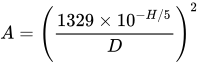
- ^ The geometric albedo
is calculated from the measured absolute magnitude
and measured diameter
via the formula:
- ^ Diameters with the text in red indicate that Brown's bot derived them from heuristically expected albedo.
| This article uses material from the Wikipedia article Metasyntactic variable, which is released under the Creative Commons Attribution-ShareAlike 3.0 Unported License. |