In astronomy, a resonant trans-Neptunian object is a trans-Neptunian object (TNO) in mean-motion orbital resonance with Neptune. The orbital periods of the resonant objects are in a simple integer relations with the period of Neptune, e.g. 1:2, 2:3, etc. Resonant TNOs can be either part of the main Kuiper belt population, or the more distant scattered disc population.[1]
Distribution
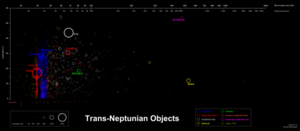
The diagram illustrates the distribution of the known trans-Neptunian objects. Resonant objects are plotted in red. Orbital resonances with Neptune are marked with vertical bars: 1:1 marks the position of Neptune's orbit and its trojans; 2:3 marks the orbit of Pluto and plutinos; and 1:2, 2:5, etc. mark a number of smaller families. The designation 2:3 or 3:2 both refer to the same resonance for TNOs. There is no ambiguity, because TNOs have, by definition, periods longer than Neptune's. The usage depends on the author and the field of research.
Origin
Detailed analytical and numerical studies of Neptune's resonances have shown that the objects must have a relatively precise range of energies.[2][3] If the object's semi-major axis is outside these narrow ranges, the orbit becomes chaotic, with widely changing orbital elements. As TNOs were discovered, more than 10% were found to be in 2:3 resonances, far from a random distribution. It is now believed that the objects have been collected from wider distances by sweeping resonances during the migration of Neptune.[4] Well before the discovery of the first TNO, it was suggested that interaction between giant planets and a massive disk of small particles would, via angular-momentum transfer, make Jupiter migrate inwards and make Saturn, Uranus, and especially Neptune migrate outwards. During this relatively short period of time, Neptune's resonances would be sweeping the space, trapping objects on initially varying heliocentric orbits into resonance.[5]
Known populations
1:1 resonance (Neptune trojans, period ~164.8 years)
A few objects have been discovered following orbits with semi-major axes similar to that of Neptune, near the Sun–Neptune Lagrangian points. These Neptune trojans, termed by analogy to the (Jupiter) Trojan asteroids, are in 1:1 resonance with Neptune. 28 are known as of February 2020:[6][7]
- 385571 Otrera (L4)
- 385695 Clete (L4)
- 2001 QR322 (L4)
- 2005 TN53 (L4)
- 2006 RJ103 (L4)
- (527604) 2007 VL305 (L4)
- 2008 LC18 (L5)
- 2010 TS191 (L4)
- 2010 TT191 (L4)
- 2011 HM102 (L5)
- (530664) 2011 SO277 (L5)
- (530930) 2011 WG157 (L4)
- 2012 UD185 (L5)
- 2012 UV177 (L4)
- 2013 KY18? (L5)
- 2013 RL124 (L4)
- 2013 TZ187 (L4)
- 2013 VX30 (L4)
- 2014 QO441 (L4)
- 2014 QP441 (L4)
- 2014 RO74 (L4)
- 2014 SC374 (L4)
- 2014 UU240 (L4)
- 2015 RW277 (L4)
- 2015 VV165 (L4)
- 2015 VW165 (L4)
- 2015 VX165 (L4)
Only 4 objects are near Neptune's L5 Lagrangian point, and the identification of one of these is insecure; the others are located in Neptune's L4 region.[8][7]
In addition, (316179) 2010 EN65 is a so-called "jumping trojan", currently transitioning from librating around L4 to librating around L5, via the L3 region.[9]
2:3 resonance ("plutinos", period ~247.94 years)
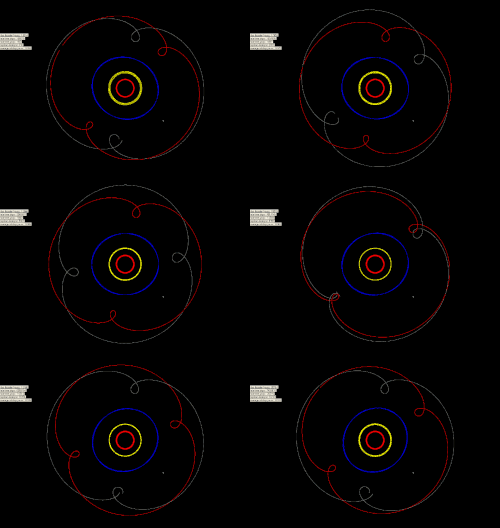

The 2:3 resonance at 39.4 AU is by far the dominant category among the resonant objects. As of February 2020, it includes 383 confirmed and 99 possible member bodies (such as (175113) 2004 PF115).[6] Of these 383 confirmed plutinos, 338 have their orbits secured in simulations run by the Deep Ecliptic Survey.[7] The objects following orbits in this resonance are named plutinos after Pluto, the first such body discovered. Large, numbered plutinos include:
- 134340 Pluto
- 90482 Orcus
- (208996) 2003 AZ84
- (455502) 2003 UZ413
- (84922) 2003 VS2
- 28978 Ixion
- (84719) 2002 VR128
- (469372) 2001 QF298
- 38628 Huya
- (33340) 1998 VG44
- (15789) 1993 SC
- (444745) 2007 JF43
- (469421) 2001 XD255
- (120216) 2004 EW95
- 47171 Lempo
- (504555) 2008 SO266
- (307463) 2002 VU130
- (55638) 2002 VE95
- (450265) 2003 WU172
- (469987) 2006 HJ123
- (508823) 2001 RX143
- (469704) 2005 EZ296
3:5 resonance (period ~275 years)
As of February 2020, 47 objects are confirmed to be in a 3:5 orbital resonance with Neptune. Among the numbered objects there are:[7][6]
- (15809) 1994 JS
- (149349) 2002 VA131
- (434709) 2006 CJ69
- (469420) 2001 XP254
- (469584) 2003 YW179
- (470523) 2008 CS190
- (503883) 2001 QF331
- (523677) 2013 UF15
- (523688) 2014 DK143
- (523731) 2014 OK394
- (523743) 2014 TA86
- (530839) 2011 UK411
- (531683) 2012 UC178
- (534074) 2011 QZ441
- (534314) 2012 SJ349
- (534314) 2012 SJ349
4:7 resonance (period ~290 years)
Another population of objects is orbiting the Sun at 43.7 AU (in the midst of the classical objects). The objects are rather small (with two exceptions, H>6) and most of them follow orbits close to the ecliptic.[7] As of February 2020, 55 4:7-resonant objects have had their orbits secured by the Deep Ecliptic Survey.[6][7] Objects with well established orbits include:[7]
- (119956) 2002 PA149
- (119066) 2001 KJ76
- (135024) 2001 KO76
- (119070) 2001 KP77
- (181871) 1999 CO153
- (118378) 1999 HT11
- (118698) 2000 OY51
- 385446 Manwë
- (385527) 2004 OK14
- (500828) 2013 GR136
- (523742) 2014 TZ85
1:2 resonance ("twotinos", period ~330 years)
This resonance at 47.8 AU is often considered to be the outer edge of the Kuiper belt, and the objects in this resonance are sometimes referred to as twotinos. Twotinos have inclinations less than 15 degrees and generally moderate eccentricities between 0.1 and 0.3.[10] An unknown number of the 2:1 resonants likely did not originate in a planetesimal disk that was swept by the resonance during Neptune's migration, but were captured when they had already been scattered.[11]
There are far fewer objects in this resonance than plutinos. Johnston's Archive counts 99 while simulations by the Deep Ecliptic Survey has confirmed 73 as of February 2020.[6][7] Long-term orbital integration shows that the 1:2 resonance is less stable than 2:3 resonance; only 15% of the objects in 1:2 resonance were found to survive 4 Gyr as compared with 28% of the plutinos.[10] Consequently, it might be that twotinos were originally as numerous as plutinos, but their population has dropped significantly below that of plutinos since.[10]
Objects with well established orbits include (in order of the absolute magnitude):[6]
- (119979) 2002 WC19
- (308379) 2005 RS43
- (312645) 2010 EP65
- (26308) 1998 SM165
- (469505) 2003 FE128
- (495189) 2012 VR113
- (137295) 1999 RB216
- (500880) 2013 JJ64
- (20161) 1996 TR66
- (470083) 2006 SG369
- (130391) 2000 JG81
- (500877) 2013 JE64
2:5 resonance (period ~410 years)
There are 57 confirmed 2:5-resonant objects as of February 2020.[7][6]
Objects with well established orbits at 55.4 AU include:
- (84522) 2002 TC302, dwarf candidate
- (495603) 2015 AM281
- (26375) 1999 DE9
- (143707) 2003 UY117
- (471172) 2010 JC80
- (471151) 2010 FD49
- (472235) 2014 GE45
- (119068) 2001 KC77
- (60621) 2000 FE8
- (38084) 1999 HB12
- (135571) 2002 GG32
- (69988) 1998 WA31
1:3 resonance (period ~500 years)
Johnston's Archive counts 14 1:3-resonant objects as of February 2020.[6] A dozen of these are secure according to the Deep Ecliptic Survey:[7]
- (136120) 2003 LG7
- (385607) 2005 EO297
- 2004 VU130
- 2006 QJ181
- 2006 SF369
- 2011 US411
- 2014 FX71
- 2015 BZ517?
- 2015 GA55
- 2015 KY173
- 2015 RA278
- 2015 RZ277?
- 2015 VM166
- 2015 VN166
Other resonances

As of February 2020, the following higher-order resonances are confirmed for a limited number of objects:[7]
Haumea


 of Haumea's weak 7:12 resonance with Neptune,
  , over the next 5 million years
Haumea is thought to be in an intermittent 7:12 orbital resonance with Neptune.[13] Its ascending node 
Coincidental versus true resonances
One of the concerns is that weak resonances may exist and would be difficult to prove due to the current lack of accuracy in the orbits of these distant objects. Many objects have orbital periods of more than 300 years and most have only been observed over a relatively short observation arc of a few years. Due to their great distance and slow movement against background stars, it may be decades before many of these distant orbits are determined well enough to confidently confirm whether a resonance is true or merely coincidental. A true resonance will smoothly oscillate while a coincidental near resonance will circulate.[citation needed] (See Toward a formal definition)
Simulations by Emel'yanenko and Kiseleva in 2007 show that (131696) 2001 XT254 is librating in a 3:7 resonance with Neptune.[16] This libration can be stable for less than 100 million to billions of years.[16]

Emel'yanenko and Kiseleva also show that (48639) 1995 TL8 appears to have less than a 1% probability of being in a 3:7 resonance with Neptune, but it does execute circulations near this resonance.[16]

Toward a formal definition
The classes of TNO have no universally agreed precise definitions, the boundaries are often unclear and the notion of resonance is not defined precisely. The Deep Ecliptic Survey introduced formally defined dynamical classes based on long-term forward integration of orbits under the combined perturbations from all four giant planets. (see also formal definition of classical KBO)
In general, the mean-motion resonance may involve not only orbital periods of the form

where p and q are small integers, λ and λN are respectively the mean longitudes of the object and Neptune, but can also involve the longitude of the perihelion and the longitudes of the nodes (see orbital resonance, for elementary examples)
An object is resonant if for some small integers (p,q,n,m,r,s), the argument (angle) defined below is librating (i.e. is bounded):[17]

where the 
The term libration denotes here periodic oscillation of the angle around some value and is opposed to circulation where the angle can take all values from 0 to 360°. For example, in the case of Pluto, the resonant angle
All new plutinos discovered during the Deep Ecliptic Survey proved to be of the type

similar to Pluto's mean-motion resonance.
More generally, this 2:3 resonance is an example of the resonances p:(p+1) (for example 1:2, 2:3, 3:4) that have proved to lead to stable orbits.[4] Their resonant angle is

In this case, the importance of the resonant angle 


i.e.
Classification methods
As the orbital elements are known with a limited precision, the uncertainties may lead to false positives (i.e. classification as resonant of an orbit which is not). A recent approach[19] considers not only the current best-fit orbit but also two additional orbits corresponding to the uncertainties of the observational data. In simple terms, the algorithm determines whether the object would be still classified as resonant if its actual orbit differed from the best fit orbit, as the result of the errors in the observations. The three orbits are numerically integrated over a period of 10 million years. If all three orbits remain resonant (i.e. the argument of the resonance is librating, see formal definition), the classification as a resonant object is considered secure.[19] If only two out of the three orbits are librating the object is classified as probably in resonance. Finally, if only one orbit passes the test, the vicinity of the resonance is noted to encourage further observations to improve the data.[19] The two extreme values of the semi-major axis used in the algorithm are determined to correspond to uncertainties of the data of at most 3 standard deviations. Such range of semi-axis values should, with a number of assumptions, reduce the probability that the actual orbit is beyond this range to less than 0.3%. The method is applicable to objects with observations spanning at least 3 oppositions.[19]
| This article uses material from the Wikipedia article Metasyntactic variable, which is released under the Creative Commons Attribution-ShareAlike 3.0 Unported License. |