A terrestrial planet, telluric planet, or rocky planet is a planet that is composed primarily of silicate rocks or metals. Within the Solar System, the terrestrial planets accepted by the IAU are the inner planets closest to the Sun, i.e. Mercury, Venus, Earth, and Mars. Among astronomers who use the geophysical definition of a planet, the Moon, Io and Europa may also be considered terrestrial planets.[1][2][3] The terms "terrestrial planet" and "telluric planet" are derived from Latin words for Earth (Terra and Tellus), as these planets are, in terms of structure, Earth-like. These planets are located between the Sun and the asteroid belt.
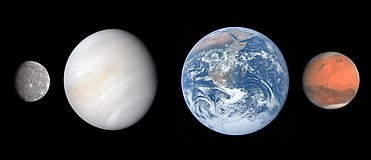
Terrestrial planets have a solid planetary surface, making them substantially different from the larger gaseous planets, which are composed mostly of some combination of hydrogen, helium, and water existing in various physical states.
Structure
All terrestrial planets in the Solar System have the same basic structure, such as a central metallic core (mostly iron) with a surrounding silicate mantle. The Earth's Moon is similar, but has a much smaller iron core; other natural satellites, such as Io, Europa, and Titan, also have internal structures similar to that of terrestrial planets.
Terrestrial planets can have surface structures such as canyons, craters, mountains, volcanoes, and others, depending on the presence of an erosive liquid and / or tectonic activity.
Terrestrial planets have secondary atmospheres, generated by volcanic out-gassing or from comet impact debris. This contrasts with the outer, giant planets, whose atmospheres are primary; primary atmospheres were captured directly from the original solar nebula.[4]
Solar System's terrestrial planets
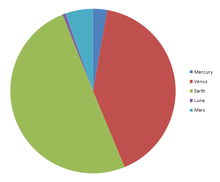

The Solar System has four terrestrial planets: Mercury, Venus, Earth and Mars. Only one terrestrial planet, Earth, has an active hydrosphere.
During the formation of the Solar System, there were many terrestrial planetesimals and proto-planets, but most merged with or were ejected by the four terrestrial planets, leaving only a few such as 4 Vesta to survive.
Dwarf planets, such as Ceres, Pluto and Eris, are similar to terrestrial planets in that they have a solid surface, but are composed of ice and rock rather than of rock and metal. Some small Solar System bodies such as Vesta are quite rocky, or in the case of 16 Psyche even metallic like Mercury, while others such as 2 Pallas are icier.
Most planetary-mass moons are ice-rock or even primarily ice. The three exceptions are Earth's moon, which has a composition much like the Earth's mantle, Jupiter's Io, which is silicate and volcanic, and Jupiter's Europa, which is believed to have an active hydrosphere.
Density trends
The uncompressed density of a terrestrial planet is the average density its materials would have at zero pressure. A greater uncompressed density indicates greater metal content. Uncompressed density differs from the true average density (also often called "bulk" density) because compression within planet cores increases their density; the average density depends on planet size, temperature distribution and material stiffness as well as composition.
The uncompressed density of terrestrial planets trends towards lower values as the distance from the Sun increases. For example, the rocky minor planet Vesta orbiting outside of Mars at 2.36 AU is less dense than Mars, at 3.5 g·cm−3, and icier Pallas, orbiting at 2.77 AU, is less dense still at 2.9 g·cm−3.
Earth's Moon has a density of 3.3 g·cm−3 and Jupiter's satellites Io and Europa are 3.5 and 3.0 g·cm−3; other large satellites are icier and typically have densities less than 2 g·cm−3.[5][6] The dwarf planets Ceres, Pluto and Eris have densities of 2.2, 1.9 and 2.5 g·cm−3, respectively. (At one point Ceres was sometimes distinguished as a 'terrestrial dwarf', vs Pluto as an 'ice dwarf', but the distinction is no longer tenable. It now appears that Ceres formed in the outer Solar System and is itself quite icy.)
Calculations to estimate uncompressed density inherently require a model of the planet's structure. Where there have been landers or multiple orbiting spacecraft, these models are constrained by seismological data and also moment of inertia data derived from the spacecraft orbits. Where such data is not available, uncertainties are inevitably higher.[7] It is unknown whether extrasolar terrestrial planets in general will show to follow this trend.
Extrasolar terrestrial planets
Most of the planets discovered outside the Solar System are giant planets, because they are more easily detectable.[8][9][10] But since 2005, hundreds of potentially terrestrial extrasolar planets have also been found, with several being confirmed as terrestrial. Most of these are super-Earths, i.e. planets with masses between Earth's and Neptune's; super-Earths may be gas planets or terrestrial, depending on their mass and other parameters.
During the early 1990s, the first extrasolar planets were discovered orbiting the pulsar PSR B1257+12, with masses of 0.02, 4.3, and 3.9 times that of Earth's, by pulsar timing.
When 51 Pegasi b, the first planet found around a star still undergoing fusion, was discovered, many astronomers assumed it to be a gigantic terrestrial,[citation needed] because it was assumed no gas giant could exist as close to its star (0.052 AU) as 51 Pegasi b did. It was later found to be a gas giant.
In 2005, the first planets orbiting a main-sequence star and which show signs of being terrestrial planets, were found: Gliese 876 d and OGLE-2005-BLG-390Lb. Gliese 876 d orbits the red dwarf Gliese 876, 15 light years from Earth, and has a mass seven to nine times that of Earth and an orbital period of just two Earth days. OGLE-2005-BLG-390Lb has about 5.5 times the mass of Earth, orbits a star about 21,000 light years away in the constellation Scorpius. From 2007 to 2010, three (possibly four) potential terrestrial planets were found orbiting within the Gliese 581 planetary system. The smallest, Gliese 581e, is only about 1.9 Earth masses,[11] but orbits very close to the star.[12] Two others, Gliese 581c and Gliese 581d, as well as a disputed planet, Gliese 581g, are more-massive super-Earths orbiting in or close to the habitable zone of the star, so they could potentially be habitable, with Earth-like temperatures.
Another possibly terrestrial planet, HD 85512 b, was discovered in 2011; it has at least 3.6 times the mass of Earth.[13] The radius and composition of all these planets are unknown.
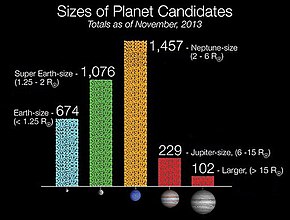
The first confirmed terrestrial exoplanet, Kepler-10b, was found in 2011 by the Kepler Mission, specifically designed to discover Earth-size planets around other stars using the transit method.[14]
In the same year, the Kepler Space Observatory Mission team released a list of 1235 extrasolar planet candidates, including six that are "Earth-size" or "super-Earth-size" (i.e. they have a radius less than 2 Earth radii)[15] and in the habitable zone of their star.[16] Since then, Kepler has discovered hundreds of planets ranging from Moon-sized to super-Earths, with many more candidates in this size range (see image).
In September 2020, astronomers using microlensing techniques reported the detection, for the first time, of an earth-mass rogue planet (named OGLE-2016-BLG-1928) unbounded by any star, and free floating in the Milky Way galaxy.[17][18][19]
List of terrestrial exoplanets
The following exoplanets have a density of at least 5 g/cm3 and a mass below Neptune's and are thus very likely terrestrial:
Kepler-10b, Kepler-20b, Kepler-36b, Kepler-48d, Kepler 68c, Kepler-78b, Kepler-89b, Kepler-93b, Kepler-97b, Kepler-99b, Kepler-100b, Kepler-101c, Kepler-102b, Kepler-102d, Kepler-113b, Kepler-131b, Kepler-131c, Kepler-138c, Kepler-406b, Kepler-406c, Kepler-409b.
Frequency
In 2013, astronomers reported, based on Kepler space mission data, that there could be as many as 40 billion Earth- and super-Earth-sized planets orbiting in the habitable zones of Sun-like stars and red dwarfs within the Milky Way.[20][21][22] 11 billion of these estimated planets may be orbiting Sun-like stars.[23] The nearest such planet may be 12 light-years away, according to the scientists.[20][21] However, this does not give estimates for the number of extrasolar terrestrial planets, because there are planets as small as Earth that have been shown to be gas planets (see Kepler-138d).[24]
Types
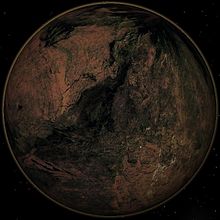
Several possible classifications for terrestrial planets have been proposed:[25]
- Silicate planet
- The standard type of terrestrial planet seen in the Solar System, made primarily of silicon-based rocky mantle with a metallic (iron) core.
- Carbon planet (also called "diamond planet")
- A theoretical class of planets, composed of a metal core surrounded by primarily carbon-based minerals. They may be considered a type of terrestrial planet if the metal content dominates. The Solar System contains no carbon planets, but does have carbonaceous asteroids.
- Iron planet
- A theoretical type of terrestrial planet that consists almost entirely of iron and therefore has a greater density and a smaller radius than other terrestrial planets of comparable mass. Mercury in the Solar System has a metallic core equal to 60–70% of its planetary mass. Iron planets are thought to form in the high-temperature regions close to a star, like Mercury, and if the protoplanetary disk is rich in iron.
- Coreless planet
- A theoretical type of terrestrial planet that consists of silicate rock but has no metallic core, i.e. the opposite of an iron planet. Although the Solar System contains no coreless planets, chondrite asteroids and meteorites are common in the Solar System. Coreless planets are thought to form farther from the star where volatile oxidizing material is more common.
| This article uses material from the Wikipedia article Metasyntactic variable, which is released under the Creative Commons Attribution-ShareAlike 3.0 Unported License. |