This is a timeline of Solar System exploration ordered by date of spacecraft launch. It includes:
- All spacecraft that have left Earth orbit for the purposes of Solar System exploration (or were launched with that intention but failed), including lunar probes.
- A small number of pioneering or notable Earth-orbiting craft.[vague]

Charted timeline of Solar System exploration, as of December 2014
It does not include:
- Centuries of terrestrial telescopic observation.
- The great majority of Earth-orbiting satellites.
- Space probes leaving Earth orbit that are not concerned with Solar System exploration (such as space telescopes targeted at distant galaxies, cosmic background radiation observatories, and so on).
- Probes that failed at launch.
The dates listed are launch dates, but the achievements noted may have occurred some time later—in some cases, a considerable time later (for example, Voyager 2, launched 20 August 1977, did not reach Neptune until 1989).
1950sEdit
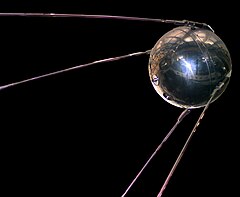
Sputnik 1 – First Earth orbiter
| Mission name | Launch date | Description | Ref(s) |
|---|---|---|---|
 Sputnik 1 Sputnik 1 | 4 October 1957 | First Earth orbiter | [1][2] |
| Sputnik 2 | 3 November 1957 | Earth orbiter, first animal in orbit, a dog named Laika | [2][3][4] |
 Explorer 1 Explorer 1 | 1 February 1958 | Earth orbiter; discovered Van Allen radiation belts | [5] |
| Vanguard 1 | 17 March 1958 | Earth orbiter; oldest spacecraft still in Earth orbit | [6] |
| Luna 1 | 2 January 1959 | First lunar flyby (attempted lunar impact?); first artificial satellite in heliocentric orbit. | [7][8][9][10] |
| Pioneer 4 | 3 March 1959 | Lunar flyby | [11][12] |
| Luna 2 | 12 September 1959 | First lunar impact, First artificial object on Moon | [10][13] |
| Luna 3 | 4 October 1959 | Lunar flyby; First images of another celestial body taken from space, most notably, the far side of Moon | [10][14] |
1960sEdit
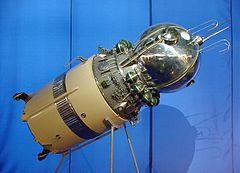
Vostok 1 – First crewed Earth orbiter

Mariner 2 – First successful Venus flyby

Mariner 4 – First successful Mars flyby

Luna 9 – First lunar lander
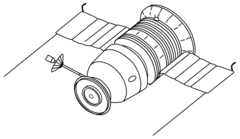
Zond 5 – First lunar flyby and return to Earth, first terrestrials to circle the Moon

Apollo 8 – First crewed lunar orbiter

Apollo 11 – First crewed lunar landing
| Mission name | Launch date | Description | Ref(s) |
|---|---|---|---|
| Pioneer 5 | 11 March 1960 | Interplanetary space investigations | [15][16] |
| Venera 1 | 12 February 1961 | First probe to another planet; Venus flyby (contact lost before flyby) | [17][18][19] |
| Vostok 1 | 12 April 1961 | First crewed Earth orbiter (Yuri Gagarin) | [20][21] |
| Ranger 1 | 23 August 1961 | Attempted lunar test flight (failed to leave Earth orbit) | [22][23][24] |
| Ranger 2 | 18 November 1961 | Attempted lunar test flight (failed to leave Earth orbit) | [24][25][26] |
| Ranger 3 | 26 January 1962 | Attempted lunar impact (missed Moon) | [24][27][28] |
| Ranger 4 | 23 April 1962 | Lunar impact (but unintentionally became the first spacecraft to hit the lunar farside and returned no data) | [24][29][30][31] |
| Mariner 2 | 27 August 1962 | First successful planetary encounter, First successful Venus flyby | [32][33][34] |
| Ranger 5 | 18 October 1962 | Attempted lunar impact (missed Moon) | [24][35][36] |
| Mars 1 | 1 November 1962 | First probe to Mars: flyby (contact lost) | [37][38] |
| Luna 4 | 2 April 1963 | Attempted lunar lander (missed Moon) | [39][40] |
| Cosmos 21 | 11 November 1963 | Attempted Venera test flight? | [41] |
| Ranger 6 | 30 January 1964 | Lunar impact (cameras failed) | [42][43] |
| Zond 1 | 2 April 1964 | Venus flyby (contact lost) | [44][45][46] |
| Ranger 7 | 28 July 1964 | Lunar impact (success) | [47][48][49] |
| Voskhod 1 | 12 October 1964 | First orbiter with multimember crew | [50][51] |
| Mariner 3 | 5 November 1964 | Attempted Mars flyby (failed to attain correct trajectory) | [52][53] |
| Mariner 4 | 28 November 1964 | First successful Mars flyby | [54][55] |
| Zond 2 | 30 November 1964 | Mars flyby (contact lost) | [46][56][57] |
| Ranger 8 | 17 February 1965 | Lunar impact | [58][59] |
| Voskhod 2 | 18 March 1965 | First space walk by Alexei Leonov | [51][60] |
| Ranger 9 | 21 March 1965 | Lunar impact | [61][62] |
| Lincoln Calibration Sphere 1 | 6 May 1965 | Oldest spacecraft still in use[citation needed] | [63] |
| Luna 5 | 9 May 1965 | Lunar impact (attempted soft landing) | [64] |
| Luna 6 | 8 June 1965 | Attempted lunar lander (missed Moon) | [65] |
| Zond 3 | 18 July 1965 | Lunar flyby | [46][66][67] |
| Luna 7 | 4 October 1965 | Lunar impact (attempted soft landing) | [68] |
| Venera 2 | 12 November 1965 | Venus flyby (contact lost) | [69][18] |
| Venera 3 | 16 November 1965 | Venus lander (contact lost) – First spacecraft to reach another planet's surface, First Venus impact | [70][18] |
| Luna 8 | 3 December 1965 | Lunar impact (attempted soft landing?) | [71] |
| Pioneer 6 | 16 December 1965 | "Space weather" observations | [72][73][74][75] |
| Luna 9 | 31 January 1966 | First lunar lander | [10][76] |
| Luna 10 | 31 March 1966 | First lunar orbiter | [77] |
| Surveyor 1 | 30 May 1966 | Lunar lander | [78][79][80] |
| Explorer 33 | 1 July 1966 | Attempted lunar orbiter (failed to attain lunar orbit) | [81][82] |
| Lunar Orbiter 1 | 10 August 1966 | Lunar orbiter | [83][84][85] |
| Pioneer 7 | 17 August 1966 | "Space weather" observations | [75][86][87] |
| Luna 11 | 24 August 1966 | Lunar orbiter | [88] |
| Surveyor 2 | 20 September 1966 | Attempted lunar lander (crashed into Moon) | [89][90] |
| Luna 12 | 22 October 1966 | Lunar orbiter | [91] |
| Lunar Orbiter 2 | 6 November 1966 | Lunar orbiter | [92][93] |
| Luna 13 | 21 December 1966 | Lunar lander | [94] |
| Lunar Orbiter 3 | 5 February 1967 | Lunar orbiter | [95][96] |
| Surveyor 3 | 17 April 1967 | Lunar lander | [97][98] |
| Lunar Orbiter 4 | 4 May 1967 | Lunar orbiter | [99][100] |
| Venera 4 | 12 June 1967 | First Venus atmospheric probe | [18][101] |
| Mariner 5 | 14 June 1967 | Venus flyby | [102][103] |
| Surveyor 4 | 14 July 1967 | Attempted lunar lander (crashed into Moon) | [104][105] |
| Explorer 35 (IMP-E) | 19 July 1967 | Lunar orbiter | [106] |
| Lunar Orbiter 5 | 1 August 1967 | Lunar orbiter | [85][107][108] |
| Surveyor 5 | 8 September 1967 | Lunar lander | [109][110] |
| Surveyor 6 | 7 November 1967 | Lunar lander, first lift-off from an extraterrestrial body | [79][111][112] |
| Apollo 4 | 9 November 1967 | Lunar programme test flight in Earth orbit (uncrewed) | [113] |
| Pioneer 8 | 13 December 1967 | "Space weather" observations | [75][114][115] |
| Surveyor 7 | 7 January 1968 | Lunar lander | [116][117] |
| Apollo 5 | 22 January 1968 | Lunar programme test flight in Earth orbit (uncrewed) | [118][119] |
| Zond 4 | 2 March 1968 | Lunar programme test flight out of Earth orbit (uncrewed) | [46][120][121][122] |
| Luna 14 | 7 April 1968 | Lunar orbiter | [123] |
| Zond 5 | 14 September 1968 | First lunar flyby and return to Earth, first life forms to circle the Moon | [46][124][125][126][127] |
| Apollo 7 | 11 October 1968 | Lunar programme test flight in Earth orbit (crewed) | [128][129] |
| Pioneer 9 | 8 November 1968 | "Space weather" observations | [75][130][131] |
| Zond 6 | 10 November 1968 | Lunar flyby and return to Earth | [46][132][133] |
| Apollo 8 | 21 December 1968 | First crewed spacecraft to leave Earth orbit, first crewed lunar orbiter | [129][134][135] |
| Venera 5 | 5 January 1969 | Venus atmospheric probe | [18][136] |
| Venera 6 | 10 January 1969 | Venus atmospheric probe | [18][137] |
| Mariner 6 | 25 February 1969 | Mars flyby | [138][139] |
| Apollo 9 | 3 March 1969 | Crewed lunar lander (LEM) flight test in Earth orbit | [129][140] |
| Mariner 7 | 27 March 1969 | Mars flyby | [141][142] |
| Apollo 10 | 18 May 1969 | Crewed lunar orbiter | [129][143][144] |
| Luna 15 | 13 July 1969 | Second attempted lunar sample return | [145][146] |
| Apollo 11 | 16 July 1969 | First crewed lunar landing and first successful sample return mission | [147][148][149][150][151] |
| Zond 7 | 7 August 1969 | Lunar flyby and return to Earth | [46][152][153] |
| Apollo 12 | 14 November 1969 | Crewed lunar landing | [154][155][156] |
1970sEdit

Mars 3 – First Mars lander
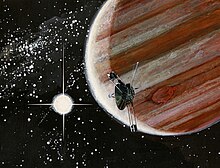
Pioneer 10 – First Jupiter flyby
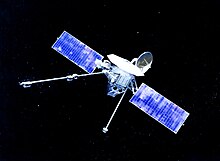
Mariner 10 – First Mercury flyby

Voyager 2 – First Uranus/first Neptune flyby
| Mission name | Launch date | Description | Ref(s) |
|---|---|---|---|
| Apollo 13 | 11 April 1970 | Crewed lunar flyby and return to Earth (crewed lunar landing aborted). Farthest from Earth a human has gone (401,056 km) | [157][158][159][160] |
| Venera 7 | 17 August 1970 | First Venus lander and the first spacecraft to land on another planet | [18][161][162] |
| Luna 16 | 12 September 1970 | First robotic lunar sample return | [10][163] |
| Zond 8 | 20 October 1970 | Lunar flyby and return to Earth | [46][164][165] |
| Luna 17/Lunokhod 1 | 10 November 1970 | First remote controlled rover | [10][166] |
| Apollo 14 | 31 January 1971 | Crewed lunar landing | [167][168][169] |
| Salyut 1 | 19 April 1971 | First space station | [170][171] |
| Mars 2 | 19 May 1971 | First Mars impact, Mars orbiter and attempted lander; First rover on Martian surface (Prop-M unsuccessful) | [172][173][174][175][176] |
| Mars 3 | 28 May 1971 | Mars orbiter, First Mars lander (lost contact after 14.5s) | [177][178][179][180][181] |
| Mariner 9 | 30 May 1971 | First Mars orbiter | [182][183] |
| Apollo 15 | 26 July 1971 | Crewed lunar landing; First crewed lunar rover | [129][184][185][186] |
| Luna 18 | 2 September 1971 | Attempted lunar sample return (crashed into Moon) | [187][188] |
| Luna 19 | 28 September 1971 | Lunar orbiter | [189] |
| Luna 20 | 14 February 1972 | Lunar robotic sample return | [190] |
| Pioneer 10 | 3 March 1972 | First Jupiter flyby | [191][192][74] |
| Venera 8 | 27 March 1972 | Venus lander | [18][193][194] |
| Apollo 16 | 16 April 1972 | Crewed lunar landing | [195][196][197] |
| Apollo 17 | 7 December 1972 | Last crewed lunar landing | [198][199][200][201] |
| Luna 21/Lunokhod 2 | 8 January 1973 | Lunar rover | [202] |
| Pioneer 11 | 5 April 1973 | Jupiter flyby and First Saturn flyby | [74][203][204] |
| Explorer 49 (RAE-B) | 10 June 1973 | Lunar orbiter/radio astronomy | [205][206] |
| Mars 4 | 21 July 1973 | Mars flyby (attempted Mars orbiter) | [207][208] |
| Mars 5 | 25 July 1973 | Mars orbiter | [209][210] |
| Mars 6 | 5 August 1973 | Mars flyby and attempted lander (failed due to damage on Mars landing) | [211][212] |
| Mars 7 | 9 August 1973 | Mars flyby and attempted lander (missed Mars) | [213][214] |
| Mariner 10 | 3 November 1973 | Lunar and Venus flybys in addition to the First Mercury flyby | [215][216][217][218] |
| Luna 22 | 29 May 1974 | Lunar orbiter | [10][219] |
| Luna 23 | 28 October 1974 | Attempted lunar sample return (failed due to damage on lunar landing) | [220] |
 Helios-A Helios-A | 10 December 1974 | Solar observations | [221][222] |
| Venera 9 | 8 June 1975 | First Venus orbiter and lander; First images from surface of Venus | [18][223][224][225] |
| Venera 10 | 14 June 1975 | Venus orbiter and lander | [18][226][227][228] |
| Viking 1 | 20 August 1975 | Mars orbiter and lander; First clear pictures from Martian surface | [229][230][231][232] |
| Viking 2 | 9 September 1975 | Mars orbiter and lander | [232][233][234][235] |
| Helios-B | 15 January 1976 | Solar observations | [236][237] |
| Luna 24 | 9 August 1976 | Lunar robotic sample return | [10][238] |
| Voyager 2 | 20 August 1977 | Jupiter/Saturn/first Uranus/first Neptune flyby | [239][240][241] |
| Voyager 1 | 5 September 1977 | Jupiter/Saturn flyby, first to exit the heliosphere | [241][242][243] |
| Pioneer Venus 1 | 20 May 1978 | Venus orbiter | [244][245] |
| Pioneer Venus 2 | 8 August 1978 | Venus atmospheric probes | [246][247] |
 ISEE-3 ISEE-3 | 12 August 1978 | Solar wind investigations; later redesignated International Cometary Explorer and performed Comet Giacobini-Zinner and Comet Halley flybys – First comet flyby | [248][249][250] |
| Venera 11 | 9 September 1978 | Venus flyby and lander | [18][251][252][253] |
| Venera 12 | 14 September 1978 | Venus flyby and lander | [18][254][255][256] |
1980sEdit

Giotto – Comet Halley flyby

Galileo – Mission to Jupiter
| Mission name | Launch date | Description | Ref(s) |
|---|---|---|---|
| Venera 13 | 30 October 1981 | Venus flyby and lander. First recording of sound on another planet. | [18][257][258][259] |
| Venera 14 | 4 November 1981 | Venus flyby and lander | [18][260][261][262] |
| Venera 15 | 2 June 1983 | Venus orbiter | [18][263][264] |
| Venera 16 | 7 June 1983 | Venus orbiter | [18][265][266] |
| Vega 1 | 15 December 1984 | Venus flyby, lander and first balloon; continued on to Comet Halley flyby | [267][268][269][270][271] |
| Vega 2 | 21 December 1984 | Venus flyby, lander and balloon; continued on to Comet Halley flyby | [271][272][273][274][275] |
 Sakigake Sakigake | 8 January 1985 | Comet Halley flyby | [276][277] |
| Giotto | 2 July 1985 | First close observation of comet (distance 596 kilometers), Comet Halley flyby | [278][279][280] |
| Suisei (Planet-A) | 18 August 1985 | Comet Halley flyby | [281][282] |
| Mir | 19 February 1986 | First modular space station (operational 1986–2000; final module added 1996) | [283][284][285] |
| Phobos 1 | 7 July 1988 | Attempted Mars orbiter/Phobos landers (contact lost) | [286][287] |
| Phobos 2 | 12 July 1988 | Mars orbiter/attempted Phobos landers (contact lost) | [288][289] |
| Magellan | 4 May 1989 | Venus orbiter | [290][291] |
| Galileo | 18 October 1989 | Venus flyby, first Asteroid flyby (Gaspra), first Asteroid moon discovery (Dactyl), first Jupiter orbiter, first Jupiter atmospheric probe | [292][293][294][295] |
1990sEdit
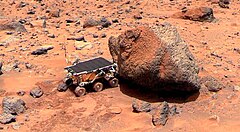
Mars Pathfinder – Mars lander and the first successful Mars rover, Sojourner

Cassini–Huygens – First Saturn orbiter and first Titan lander
| Mission name | Launch date | Description | Ref(s) |
|---|---|---|---|
| Hiten (MUSES-A) | 24 January 1990 | Lunar flyby and orbiter | [296][297] |
| Hubble Space Telescope | 24 April 1990 | Orbital space telescope (operational since 1990[needs update]) | [298][299][300] |
| Ulysses | 6 October 1990 | Solar polar orbiter | [301][302][303] |
| Yohkoh (Solar-A) | 30 August 1991 | Solar observations (1991–2001) | [304][305] |
| Mars Observer | 25 September 1992 | Attempted Mars orbiter (contact lost) | [306][307] |
| Clementine | 25 January 1994 | Lunar orbiter/attempted asteroid flyby (contact lost) | [308][309][310] |
| WIND | 1 November 1994 | Solar wind observations | [311][312] |
| SOHO | 2 December 1995 | Solar observatory (operational since 1996[needs update]) | [313][314][315] |
| NEAR Shoemaker | 17 February 1996 | Eros orbiter, first near-Earth asteroid flyby, first asteroid orbit and first asteroid landing | [316][317][318] |
| Mars Global Surveyor | 7 November 1996 | Mars orbiter | [319][320] |
 Mars 96 Mars 96 | 16 November 1996 | Attempted Mars orbiter/landers (failed to escape Earth orbit) | [321][322] |
| Mars Pathfinder | 4 December 1996 | Mars lander and first successful planetary rover | [323][324][325] |
| ACE | 25 August 1997 | Solar wind and "space weather" observations (operational since 1998) | [326][327] |
 Cassini–Huygens Cassini–Huygens | 15 October 1997 | First Saturn orbiter and first outer planet lander | [328][329][330][331][332] |
| Lunar Prospector | 7 January 1998 | Lunar orbiter | [333][334] |
| Nozomi (Planet-B) | 3 July 1998 | Attempted Mars orbiter (failed to enter Mars orbit) | [335][336] |
| Deep Space 1 (DS1) | 24 October 1998 | Asteroid and comet flyby | [337][338] |
  ISS ISS | 20 November 1998 | International space station | [339][340] |
| Mars Climate Orbiter | 11 December 1998 | Attempted Mars orbiter (orbit insertion failed; entered atmosphere and was destroyed) | [341][342] |
| Mars Polar Lander/Deep Space 2 (DS2) | 3 January 1999 | Attempted Mars lander/penetrators (contact lost) | [343][344][345] |
| Stardust | 7 February 1999 | First comet coma sample return (returned 15 January 2006) | [346][347][348] |
2000sEdit
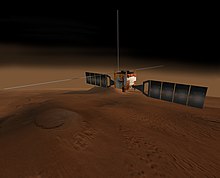
Mars Express/Beagle 2 – First planetary mission by the ESA
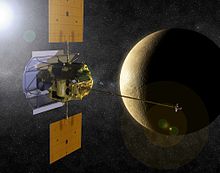
MESSENGER – First Mercury orbiter
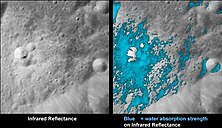
Chandrayaan-1 – Water Around Fresh Moon Crater
| Mission name | Launch date | Description | Ref(s) |
|---|---|---|---|
| 2001 Mars Odyssey | 7 April 2001 | Mars orbiter | [349][350] |
| Genesis | 8 August 2001 | First solar wind sample return | [351][352][353][354] |
| CONTOUR | 3 July 2002 | Attempted flyby of comet nuclei (Encke, Schwassmann-Wachmann-3, and optionally a third one; lost in space) | [355][356] |
| Hayabusa (MUSES-C) | 9 May 2003 | Asteroid lander and first sample return from asteroid | [357][358][359] |
 Mars Express/Beagle 2 Mars Express/Beagle 2 | 2 June 2003 | Mars orbiter/attempted lander (lander failure) | [360][361][362][363] |
| Mars Exploration Rover Spirit | 10 June 2003 | Mars rover | [364][365] |
| Mars Exploration Rover Opportunity | 8 July 2003 | Mars rover | [366][367] |
| SMART-1 | 27 September 2003 | Lunar orbiter | [368][369] |
| Rosetta/Philae | 2 March 2004 | Asteroid Šteins and Lutetia flybys; first comet orbiter and lander (Landed in November 2014) | [370][371][372][373] |
| MESSENGER | 3 August 2004 | First Mercury orbiter (Achieved orbit 18 March 2011) | [374][375][376] |
| Deep Impact | 12 January 2005 | Comet flyby and impact | [377][378][379][380] |
| Mars Reconnaissance Orbiter | 12 August 2005 | Mars orbiter | [381][382] |
| Venus Express | 9 November 2005 | Venus polar orbiter | [383][384] |
| New Horizons | 19 January 2006 | First Pluto/Charon flyby (on 14 July 2015); continued on to 486958 Arrokoth flyby (on 1 January 2019) | [385][386][387][388] |
| Hinode (Solar-B) | 22 September 2006 | Solar orbiter | [389][390] |
| STEREO | 26 October 2006 | Two spacecraft, solar orbiters | [391][392][393] |
| Phoenix | 4 August 2007 | Mars polar lander (Mars landing on 25 May 2008) | [394][395] |
| SELENE (Kaguya) | 14 September 2007 | Lunar orbiters | [396][397][398][399] |
| Dawn | 27 September 2007 | Asteroid Ceres and Vesta orbiter (Entered orbit around Vesta on 16 July 2011 and around Ceres on 6 March 2015) | [400][401][402] |
 Chang'e 1 Chang'e 1 | 24 October 2007 | Lunar orbiter | [403][404][405] |
 Chandrayaan-1 Chandrayaan-1 | 22 October 2008 | Lunar orbiter and impactor; discovered water on the Moon | [406][407][408] |
| Herschel Space Observatory | 14 May 2009 | Infrared space telescope at Sun–Earth L2 Lagrange point | [409][410] |
| Lunar Reconnaissance Orbiter/LCROSS | 18 June 2009 | Lunar polar orbiter and lunar impactor | [411][412][413][414] |
| WISE (NEOWISE) | 14 December 2009 | Infrared survey of celestial sky (WISE mission); later Near-Earth object survey (NEOWISE mission) | [415][416][417] |
2010sEdit

Mars Science Laboratory – Mars lander and large rover
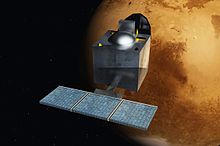
Mangalyaan – First Indian Mars orbiter
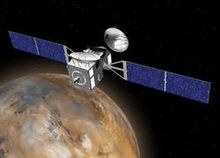
Trace Gas Orbiter – ESA/Roscosmos Mars orbiter
| Mission name | Launch date | Description | Ref(s) |
|---|---|---|---|
| Solar Dynamics Observatory | 11 February 2010 | Continuous solar monitoring | [418][419] |
| Akatsuki (Planet-C) | 20 May 2010 | Venus orbiter (orbit insertion failed in 2010 / successful orbit insertion on 7 December 2015) | [420][421][422] |
 PICARD PICARD | 15 June 2010 | Solar monitoring | [423][424] |
| Chang'e 2 | 1 October 2010 | Lunar orbiter, Asteroid 4179 Toutatis flyby | [405][425][426] |
| Juno | 5 August 2011 | Jupiter orbiter | [427][428] |
| GRAIL | 10 September 2011 | Two spacecraft, Lunar orbiters | [429][430][431] |
| Fobos-Grunt and Yinghuo-1 | 8 November 2011 | Attempted Phobos sample return and Mars orbiter, respectively; both failed to escape Earth orbit | [432][433] |
| Mars Science Laboratory (Curiosity rover) | 26 November 2011 | Mars rover (landed 6 August 2012) | [434][435] |
| Van Allen Probes (RBSP) | 30 August 2012 | Earth Van Allen radiation belts study | [436][437][438] |
| IRIS | 28 June 2013 | Solar observations | [439] |
| LADEE | 7 September 2013 | Lunar orbiter | [440][441] |
| Hisaki | 14 September 2013 | Planetary atmosphere observatory | [442] |
| Mars Orbiter Mission (Mangalyaan) | 5 November 2013 | Mars orbiter | [443][444][445] |
| MAVEN | 18 November 2013 | Mars orbiter | [446][447] |
| Chang'e 3 | 1 December 2013 | Lunar lander and rover (first lander since Soviet Luna 24 in 1976) | [405][448][449][450] |
| Chang'e 5-T1 | 23 October 2014 | Circumlunar mission and Earth reentry; technology demonstration to prepare for Chang'e 5 mission | [451] |
| Hayabusa2 / MASCOT | 3 December 2014 | Asteroid lander and sample return (sample returned 5 December 2020), first asteroid rover | [359][452][453] |
| PROCYON | 3 December 2014 | Comet observer and attempted asteroid flyby (engine failure) | [454] |
| DSCOVR | 11 February 2015 | Solar observation | [455][456] |
| ExoMars Trace Gas Orbiter and EDM lander | 14 March 2016 | Mars orbiter and attempted lander (lander failure) | [457][458] |
| OSIRIS-REx | 8 September 2016 | Asteroid sample return mission (sample return scheduled for September 2023) | [459][460] |
| InSight | 5 May 2018 | Mars lander | [461][462] |
| Queqiao | 20 May 2018 | Relay satellite for Chang'e 4 in Halo orbit around Earth–Moon L2 Lagrange point | [463] |
| Parker Solar Probe | 12 August 2018 | Solar corona probe, closest solar approach (0.04 AU) | [464][465] |
| BepiColombo | 19 October 2018 | Two Mercury orbiters (orbit insertion planned in December 2025) | [466][467] |
| Chang'e 4 | 7 December 2018 | Lunar lander and rover, first landing on the lunar far side | [405][468][469] |
 Beresheet Beresheet | 22 February 2019 | Attempted lunar lander (crashed into Moon) | [470][471] |
| Chandrayaan-2 | 22 July 2019 | Lunar orbiter; attempted lander and rover (contact lost during final stage of descent) | [472][473] |
2020sEdit
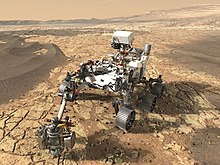
NASA's Perseverance rover
| Mission name | Launch date | Description | Ref(s) |
|---|---|---|---|
| SolO | 10 February 2020 | Sun-observing satellite | [474][475][476] |
 Mars Hope Mars Hope | 19 July 2020 | Mars orbiter | [477] |
| Tianwen-1 | 23 July 2020 | Mars orbiter, lander, and rover | [478] |
| Mars 2020 | 30 July 2020 | Mars rover and helicopter drone; first powered flight on another planet | [479][480][481] |
| Chang'e 5 | 23 November 2020 | Lunar sample return | [405][482] |
Planned or scheduledEdit
Main article: List of proposed Solar System spacecraft
| This article uses material from the Wikipedia article Metasyntactic variable, which is released under the Creative Commons Attribution-ShareAlike 3.0 Unported License. |